
You start a GLP-1, maybe semaglutide or tirzepatide, because you're tired of white-knuckling appetite, thinking about food all day, and trying plans that never seem to stick. A few weeks later, the scale may be moving, your portions may feel more manageable, and then a different question sneaks in: why do I feel a little more on edge?
That question is more common than many people expect. Some people say GLP-1s help them feel calmer because cravings quiet down and their health starts improving. Others notice restlessness, poor sleep, or a jump in anxiety that feels new. Both experiences can be real.
That tension is exactly why glp-1 and anxiety is such an important topic. The science isn't pointing in one simple direction. Some studies suggest higher rates of anxiety and other psychiatric symptoms in some groups. Other research suggests semaglutide may be linked to fewer new anxiety diagnoses and less worsening anxiety in some patients.
A smart way to think about this is not, "Are GLP-1s good or bad for mood?" It's closer to, "Who tends to feel better, who might feel worse, and how do you monitor the difference early?" That question is more useful in real life, especially if you're balancing weight goals, busy workdays, family life, and mental bandwidth.
Navigating the Conversation Around GLP-1s and Mood
A common version of this story looks like this: someone starts a GLP-1 after years of frustrating diet cycles, feels hopeful for the first time in a while, then hears two very different things online. One friend says, "My food noise got so much better and I felt more in control." Another says, "I got anxious and couldn't tell if it was the medication or everything changing at once."
That confusion makes sense. GLP-1 medications affect appetite, digestion, blood sugar, and brain signaling. So when mood shifts happen, it can be hard to tell what belongs to the drug, what belongs to rapid body changes, and what may have already been simmering under the surface.
For many adults, this isn't just a medical question. It's a life question. If eating has been stressful for years, then changing hunger cues can bring relief, but it can also unsettle routines, habits, and coping patterns.
What matters most: A mood change after starting a GLP-1 doesn't automatically mean the medication is harming you, and feeling better doesn't prove it's helping your mental health directly. It means your system is adapting, and that deserves attention.
The clearest approach is a balanced one. Look at the brain science, look at the human data, and then look at your own timeline. That's how glp-1 and anxiety becomes less of a rumor-filled topic and more of a practical health conversation.
Personalized Compounded GLP-1
Looking for Semaglutide or Tirzepatide? Start your free assessment now!
How GLP-1 Medications Interact With Your Brain
GLP-1 is often described as a gut hormone, and that's true, but it's only part of the story. These medications don't just work in the stomach and pancreas. They also interact with the brain.
One useful analogy is to think of GLP-1 receptors as docking stations. They're located in places involved in appetite, stress response, and internal regulation. When a GLP-1 medication activates those docking stations, it can change more than hunger.
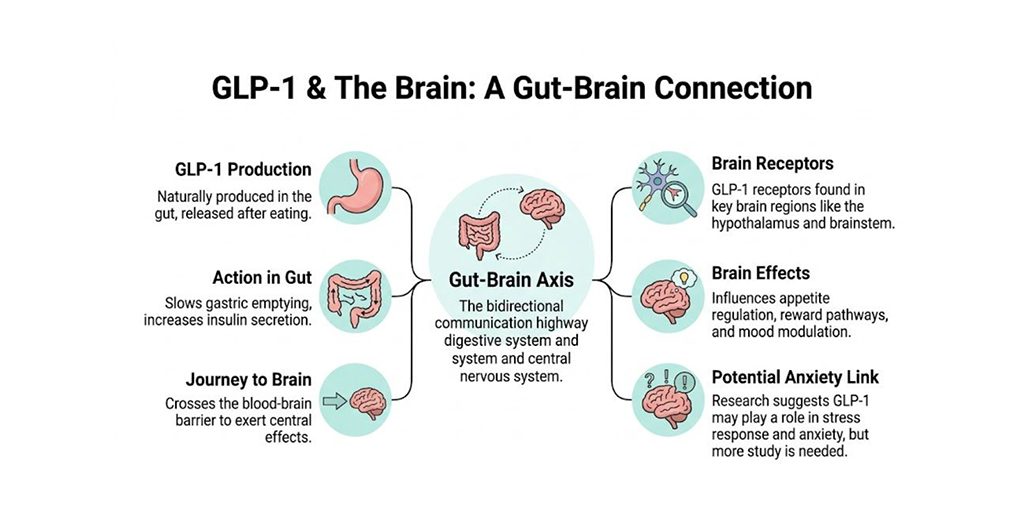
People often first learn about these medications through weight loss discussions, like guides to GLP-1 drugs for weight loss. But the gut-brain link is a big reason experiences can feel broader than appetite alone.
The calming-signal theory
One proposed pathway involves GABA, a neurotransmitter often described as one of the brain's main calming signals. GLP-1 receptor agonists can influence GABA release in brain regions like the amygdala, which is involved in fear and threat processing. Preclinical work suggests this may increase anxiety-like behavior in some settings, and a social media analysis found 353 mentions of anxiety after starting GLP-1s, with 20 to 30% of users reporting symptom onset within 4 to 8 weeks of titration, according to a review of GLP-1 psychiatric effects.
That doesn't mean the medication will make everyone anxious. It means there is a biologically plausible reason why some people might feel more activated, especially early in treatment or during dose increases.
The inflammation-and-metabolism theory
There's another plausible pathway that points the other way. Some early clinical and animal findings suggest GLP-1 receptor agonists may have anxiolytic, or anxiety-reducing, effects through anti-inflammatory actions and improved insulin sensitivity in the brain.
In plain language, if the brain is getting more stable metabolic signaling and less inflammatory stress, mood regulation may improve. That could help explain why some people report better emotional steadiness as appetite becomes less chaotic and blood sugar patterns improve.
Why the same signal can feel different
People often misunderstand this. They hear "GLP-1 acts on the brain" and assume there should be one predictable mood outcome. Biology rarely works that way.
A signal that reduces cravings for one person might feel like relief. For someone else, especially if sleep worsens, eating patterns change abruptly, or they have a history of anxiety, that same adjustment might feel unsettling.
The brain doesn't experience medication in a vacuum. It experiences medication alongside sleep, stress, appetite changes, expectations, and previous mental health patterns.
This is why clinicians often pay attention to baseline anxiety symptoms and dose titration. If the medicine affects both body and brain, then a slower, more observant start can make the experience easier to interpret.
Exploring the Conflicting Evidence on Anxiety
If you've searched glp-1 and anxiety online, you've probably seen strong claims in both directions. The research itself is mixed, so the honest answer isn't neat. Some studies raise concern. Others suggest possible mental health benefits.

Research that suggests higher anxiety risk
One of the most discussed studies is a 2024 retrospective cohort study of over 2 million adults with obesity in a U.S. community healthcare database. It compared GLP-1 receptor agonist users with matched non-users over a 5-year follow-up. The study found a hazard ratio of 1.98 for any psychiatric disorder and 2.08 for anxiety, which reflects a 108% increased risk for anxiety compared with non-users, according to the Pediatric Research study.
That same study also reported increased risks for other psychiatric outcomes, including major depressive disorder and suicidal ideation or attempts. The signal wasn't evenly distributed across all groups. Risk patterns varied by age, sex, and race, and some individual GLP-1 medications appeared to carry higher observed psychiatric risks than others.
Those findings are important because the study was large and based on real-world U.S. healthcare data. Real-world data can capture people with more varied health profiles than tightly controlled trials. That makes the findings clinically relevant, especially for routine prescribing.
What that kind of study can and can't prove
A hazard ratio tells you about an observed association over time. It doesn't prove direct cause in every case. That's a key distinction.
People prescribed GLP-1s for obesity may already differ from non-users in ways that affect mental health risk. Obesity itself is linked with higher baseline mental health burden. Even with matching methods, researchers can't perfectly control every factor, such as life stress, prior symptoms that were never coded, or what was happening during weight change.
So the study is not something to dismiss, but it's also not the final word.
Research that suggests lower anxiety risk
On the other side, there is evidence pointing toward benefit in some populations. A 2024 Epic Research study found semaglutide users had a lower likelihood of new anxiety diagnoses versus non-users, and other data discussed by experts reported an adjusted hazard ratio of 0.62 for worsening anxiety with semaglutide, which corresponds to a 38% risk reduction, according to expert discussion summarizing the contrasting evidence.
Related reporting in that same evidence set described lower rates of anxiety, suicidality, and sick leave among some patients with diabetes using semaglutide compared with other therapies. The same body of discussion also noted that the FDA's ongoing review of suicidality reports has not found an association in large trials, while also noting that very small event numbers mean small risks can't be fully ruled out.
This paints a very different picture. In some people, especially where weight loss and metabolic improvements reduce distress, GLP-1 therapy may line up with improved mental well-being rather than worsening symptoms.
A side-by-side view
| Evidence direction | What it found | Why it matters |
| Higher observed risk | Large real-world cohort data found HR 2.08 for anxiety and HR 1.98 for any psychiatric disorder in GLP-1 users versus matched non-users in one study | Suggests clinicians shouldn't ignore mood monitoring |
| Lower observed risk | Semaglutide users in other analyses had a lower likelihood of new anxiety diagnoses, and one report cited HR 0.62 for worsening anxiety | Suggests some patients may benefit mentally as metabolic health improves |
Why these findings don't cancel each other out
At first glance, these results seem impossible to reconcile. But they're not necessarily measuring the same thing in the same people under the same conditions.
Different studies can vary by:
- Patient population: People with diabetes may respond differently than people using GLP-1s primarily for obesity.
- Outcome definition: "New anxiety diagnosis" is not the same as "worsening anxiety symptoms" or "any psychiatric disorder."
- Time window: Early treatment effects can look different from longer follow-up.
- Specific medication: The large cohort study reported variation among individual GLP-1 drugs.
- Real-world context: Rapid weight loss, sleep disruption, nausea, and major routine changes may shape mood just as much as receptor-level biology.
Conflicting evidence doesn't mean the science is useless. It means you need context before applying it to a real person.
A more grounded way to read the data
If you want one simple takeaway, use this: GLP-1s appear capable of helping anxiety in some people and aggravating it in others. The question is less about picking one headline and more about identifying which pattern fits your health profile.
That matters because patients often make one of two mistakes. They either ignore anxiety because they assume all symptoms are temporary, or they panic over any change because they saw a scary post online. Neither reaction is very helpful.
A better response is measured and specific. Watch for timing, intensity, triggers, and whether symptoms improve as your body adjusts or worsen as the dose rises. That kind of detail gives your clinician something useful to work with.
Why GLP-1 Experiences and Mood Effects Can Vary
Two people can take the same medication and tell completely different stories about it. That's not unusual in medicine, but it feels especially pronounced with GLP-1s because these drugs sit at the intersection of metabolism, appetite, reward, and daily routine.

Your starting point matters
A person with steady mood, decent sleep, and a predictable eating pattern may experience appetite suppression as relief. A person with a history of anxiety, emotional eating, insomnia, or past depression may experience the same shift as more destabilizing.
This isn't a character issue. It's context.
Someone who already runs a little "high alert" may be more sensitive to body sensations. Mild nausea, less interest in food, a faster heartbeat from stress, or disrupted sleep can all be interpreted by the brain as signs that something is off.
The speed of weight loss can shape mood
Rapid change can feel exciting, but it can also be physiologically and emotionally intense. A 2024 Scientific Reports study described in a clinical summary reported a 1.2 to 1.5 times increased anxiety risk during the first 6 months of GLP-1 therapy, with anxiety sometimes correlating with BMI drops greater than 2 kg per month and HAM-A score increases of 4 to 6 points in vulnerable subgroups, according to this summary of the gut-brain connection and mental well-being.
That doesn't mean fast progress is bad. It means the body sometimes experiences rapid weight change as a stressor, not just a win.
Drug effect versus life effect
People often ask whether anxiety is "from the medication" or "from everything changing." In real life, those two can overlap.
Examples help:
- Body sensation route: You feel less hungry, mildly nauseated, and sleep a bit worse after a dose change. Your nervous system becomes more reactive.
- Identity route: You lose weight quickly and suddenly get comments from coworkers or family. That attention feels good one day and uncomfortable the next.
- Routine route: You used to use food to settle stress after work. Now that pattern is disrupted, but no replacement coping habit is in place yet.
All three can produce anxiety. Only one is a direct medication effect in the narrowest sense.
For people comparing medication options, this is one reason nuance matters in discussions like comparing semaglutide and tirzepatide. The "best" fit isn't just about the scale. It's also about how your body and mind tolerate the process.
The same appetite change can carry different meaning
One person thinks, "I'm finally free from constant cravings." Another thinks, "I don't recognize my hunger cues and that makes me uneasy." Both reactions are understandable.
Some of the distress around GLP-1s isn't only about chemistry. It's about losing a familiar pattern before a new one feels stable.
Here's a short explainer that captures why the experience can feel so personal:
Variables that often change the experience
- Dose changes: Some people notice more symptoms right after titration than at a stable dose.
- Sleep quality: A rough week of sleep can make normal adjustment feel like an anxiety spiral.
- Eating pattern shifts: Long gaps without enough protein or hydration can leave people jittery or unwell.
- Mental health history: Prior anxiety or depression may lower the threshold for symptom flare.
- Social context: Weight loss can change relationships, comments from others, and self-image in ways that are emotionally complicated.
When glp-1 and anxiety show up together, the most useful question is often not "Is this real?" It is. The better question is "What kind of anxiety is this, what seems to trigger it, and what changed right before it started?"
A Practical Guide to Monitoring Your Mental Wellness
The safest way to use a medication with mixed mood data is to monitor your response on purpose. Not obsessively. Not fearfully. Just clearly.

What to track each week
You don't need a complicated spreadsheet. A notes app or notebook works well. The goal is to create a simple record that helps you and your clinician spot patterns.
Write down:
- Dose timing: When you took the medication and whether symptoms changed after a dose increase.
- Anxiety pattern: What the anxiety felt like, such as racing thoughts, chest tightness, restlessness, or dread.
- Sleep and appetite: Whether you were sleeping poorly, eating far less than usual, or skipping meals.
- Context clues: Stress at work, caffeine changes, travel, illness, or major routine shifts.
Duration: Whether the feeling passed within a day or stayed most of the week.
A lot of early confusion clears up once you can see a timeline on paper.
Know the difference between adjustment and persistence
Some people have a short period of feeling "off" after starting or increasing a GLP-1. Mild restlessness during adjustment can happen. What deserves closer attention is a pattern that becomes more intense, more frequent, or more disruptive.
The early-treatment period matters because one summary of a 2024 Scientific Reports study reported an increased anxiety risk during the first 6 months, with greater concern when weight loss was moving quickly and anxiety scores rose in vulnerable groups, as described in this first-month GLP-1 context article and supported by the previously noted clinical summary.
Use a shared language with your clinician
You don't need to diagnose yourself, but it helps to describe symptoms in a structured way. Many clinicians use tools like the GAD-7 as a conversation aid. The point isn't to reduce your experience to a number. It's to make your symptoms easier to compare over time.
Practical rule: If anxiety is making it hard to sleep, work, eat regularly, or function socially, it's worth reporting even if you're not sure the medication caused it.
A simple check-in template
Try this once a week:
| Question | What to note |
| When did symptoms start? | Before starting, after the first dose, or after titration |
| How strong were they? | Mild, moderate, or severe |
| What else changed? | Sleep, stress, food intake, caffeine, illness |
| Are they improving? | Better, same, or worse over several days |
| Are there red flags? | Panic, hopelessness, severe insomnia, self-harm thoughts |
This kind of monitoring creates quick wins and long-term value. It helps you avoid guessing, and it gives your provider better information to keep care safe, reliable, and designed for consistency.
How to Talk to Your Provider About Anxiety
People often wait too long to mention mood changes because they don't want to seem dramatic or they worry they'll be told to stop treatment immediately. In practice, a clear conversation is usually much more productive than silent worry.
A provider can only help with what they can see. "I feel weird" is honest, but it doesn't give much to work with. "I started feeling restless two days after my dose increase, I'm waking up at night, and it's happened for two weeks in a row" is much easier to evaluate.
What to say in a visit or message
If you're not sure how to start, try one of these:
- "My appetite changes are going well, but my mood feels different and I'd like to review whether it's part of the adjustment period."
- "I've noticed more anxiety since starting this medication, and I tracked when it happens. Can we look at whether the timing fits the dose?"
- "I'm not in crisis, but I don't feel like myself. I'd like help deciding whether this is temporary, dose-related, or something else."
- "My sleep has changed, and I think that's feeding into my anxiety. What should we adjust first?"
These phrases keep the conversation collaborative. They also help avoid the false choice between "ignore it" and "quit immediately."
Questions worth asking
Some questions open better discussions than others. Consider asking:
- Could this be related to dose timing or titration speed?
- Are my eating and hydration patterns making the anxiety worse?
- What symptoms suggest normal adjustment, and what symptoms mean I should contact you sooner?
- Do my mental health history or current stressors change how we should monitor this?
- Would it make sense to hold at the current dose instead of increasing right now?
Those questions give your provider room to individualize the plan.
What your provider is trying to sort out
In most cases, a clinician is asking a few practical questions behind the scenes:
| Clinical question | Why it matters |
| Is this temporally linked to the medication? | Symptoms that start after initiation or titration may suggest a treatment-related effect |
| Is this a worsening of a prior condition? | Baseline anxiety can flare during any major body or routine change |
| Are there contributing factors? | Sleep loss, low intake, stress, and nausea can amplify anxiety |
| Is the current plan still appropriate? | Sometimes the right move is slower titration, closer follow-up, or additional support |
Bring observations, not conclusions. You don't need to prove what caused the symptom. You just need to describe what changed and when.
When to speak up urgently
You don't need to wait for the next routine check-in if symptoms feel severe. Sudden mood deterioration, severe agitation, suicidal thoughts, or inability to function deserve prompt medical attention.
That's not overreacting. It's good clinical judgment.
Frequently Asked Questions on GLP-1s and Anxiety
Can I use a GLP-1 if I already have anxiety?
Possibly, yes. Having anxiety doesn't automatically rule out GLP-1 treatment. It usually means your prescribing plan should include more deliberate monitoring, a realistic conversation about your history, and attention to sleep, eating patterns, and dose changes.
People with pre-existing anxiety often do best when they don't treat mental health as a side topic. If you're already managing anxiety with therapy, medication, or both, let your prescriber know from the start. That helps them interpret new symptoms more accurately.
If anxiety starts after I begin treatment, does it usually last?
Not always. Some people notice symptoms mainly during initiation or after titration, then settle once the dose stabilizes and daily routines adjust. Others find the pattern persists until the plan changes.
The key isn't to assume it will either disappear on its own or become permanent. Watch the trend. If the anxiety is easing as your body adapts, that's one pattern. If it's escalating, interfering with sleep or work, or continuing week after week, that deserves reassessment.
How can I tell whether it's anxiety or just normal body adjustment?
Look for the impact on function. Temporary body adjustment may feel like mild unease, low appetite, or a few odd days after a dose change. Anxiety is more concerning when it brings persistent racing thoughts, panic, dread, poor concentration, disrupted sleep, or avoidance of normal activities.
Another clue is timing. If symptoms reliably spike around dose increases, that pattern is useful. If they track more with work stress, under-eating, or insomnia, those factors may be major drivers.
Do semaglutide and tirzepatide affect mood the same way?
Not necessarily. People often assume all GLP-1-based treatments feel identical, but individual responses can differ. Even within the same medication class, one person may tolerate one product smoothly and another less comfortably.
The best interpretation isn't based on internet rankings. It's based on your actual response pattern, your health history, and your provider's judgment.
Should I stop the medication on my own if I feel anxious?
It's usually better to contact your provider before making a sudden decision, unless you're having an emergency or were told in advance to stop under specific circumstances. Stopping without a plan can create another layer of confusion, especially if appetite, routine, or stress changes at the same time.
If symptoms are severe or you have thoughts of self-harm, seek urgent medical help right away. Safety comes first.
Do supportive therapies have a role?
They can. The exact mix depends on the person, but supportive care often matters a lot. That may include therapy, sleep support, more stable meal structure, hydration, stress management, and slower dose progression.
For people interested in a broader metabolic-health plan, some clinicians also discuss complementary options such as NAD+ support or peptides like Sermorelin in appropriate contexts. Those conversations should stay individualized and should never replace direct evaluation of new anxiety symptoms.
The practical takeaway is simple: don't treat mental wellness as separate from weight care. The strongest plans account for both.
Disclaimer: TRAVA is not affiliated with, Mounjaro, Ozempic, Rybelsus, Saxenda, Trulicity, Wegovy, or Zepbound. However, we do offer alternatives such as Semaglutide and Tirzepatide. Before beginning any treatment, it's essential to consult with a licensed healthcare provider to ensure the best approach for your individual health needs.