
You wake up tired, even after a decent night of sleep. Your workouts feel harder. The scale seems stuck, or moving in the wrong direction. You reread the same email three times because your brain feels slow. If you're in your 40s or 50s, it's easy to assume this is just perimenopause or menopause.
Sometimes it is. Sometimes it isn't.
A common source of confusion is that hypothyroidism and menopause can look a lot alike from the outside, even though they're not the same process. Both can affect energy, mood, weight, sleep, skin, hair, and mental clarity. That overlap is why many women spend months, or longer, trying to push through symptoms that deserve a closer look.
If you're also pursuing weight loss, metabolic health, or better aging support with options like GLP-1s, NAD+, or peptides, thyroid function matters even more. A body that isn't getting or using thyroid hormone well may not respond to your broader plan the way you'd expect. That's not a personal failure. It's physiology.
Navigating the Crossroads of Your Health
Many women first notice the problem as a vague sense that their body has changed its rules. The habits that used to work, steady meals, regular walks, strength training, decent sleep, no longer produce the same results. You may feel heavier, slower, colder, or mentally less sharp, and none of that neatly fits into one box.
The conditions of hypothyroidism and menopause often collide.
Thyroid problems are much more common in women, especially in midlife. Women face 3 to 7 times greater risk than men, and 70% of hypothyroidism cases are diagnosed in women over 50, according to a PLOS One review on hypothyroidism in menopausal women. That timing matters because it overlaps with the average age of menopause.
One study cited in that review found a 27.3% prevalence in postmenopausal women, which means roughly 2 to 3 out of every 10 menopausal women in that study were affected. Put plainly, this is not a niche issue.
Why this gets missed so often
Menopause is expected. Thyroid dysfunction is often quieter.
If a woman reports fatigue, mood shifts, weight gain, and brain fog in midlife, those symptoms may be blamed on hormonal transition alone. Sometimes that shortcut delays testing. Sometimes it leads to treatment for one issue while another issue keeps driving symptoms in the background.
Practical rule: If symptoms feel broader, more persistent, or less responsive than you'd expect, it's reasonable to ask whether thyroid function has been fully checked.
That matters even more for busy adults using digital care. A well-run telehealth model for hormone and metabolic support can make it easier to review symptoms, labs, medications, and follow-up in one place, especially when your schedule doesn't leave much room for repeated office visits.
Personalized Compounded NAD+
Looking for anti-aging solutions? Start your free assessment now!
The key mindset shift
This isn't about deciding whether your symptoms are "really menopause" or "really thyroid."
It's about recognizing that both can happen at the same time, and when they do, they can amplify each other. Once you understand that, the next steps get clearer. You stop guessing, and you start asking better questions.
Decoding the Symptom Overlap
The confusion starts with a simple fact. The classic symptom list for menopause looks a lot like the classic symptom list for hypothyroidism.
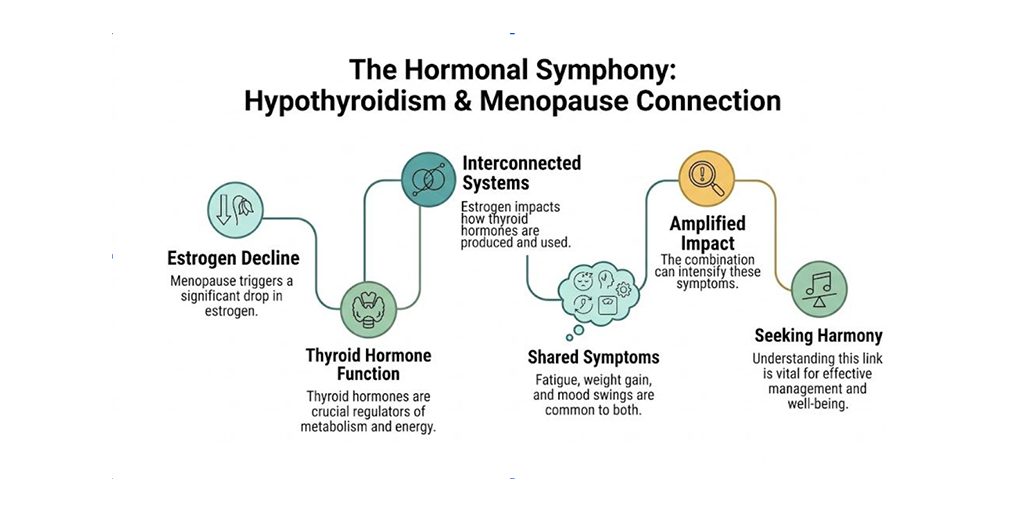
Fatigue, weight changes, mood changes, hair thinning, and brain fog all live in both worlds. That doesn't mean you should try to diagnose yourself from a checklist. It does mean symptom patterns are worth noticing, especially if one issue seems more dominant than the others.
Hypothyroidism vs menopause symptom comparison
| Symptom | Common in Hypothyroidism | Common in Menopause | Key Differentiator (If Any) |
| Fatigue | Yes | Yes | Thyroid-related fatigue often feels more constant, not just tied to poor sleep or night sweats |
| Weight gain or harder weight loss | Yes | Yes | Hypothyroidism often comes with a general metabolic slowdown |
| Brain fog | Yes | Yes | Both can affect focus and memory, so labs matter more than symptoms alone |
| Mood changes | Yes | Yes | Menopause may track with cycle changes early on, thyroid issues may feel more steady and low-energy |
| Hair thinning | Yes | Yes | Thyroid-related changes may come with drier texture and more diffuse shedding |
| Dry skin | Yes | Can happen | More suggestive of hypothyroidism when paired with cold intolerance and constipation |
| Cold intolerance | Yes | Less typical | Feeling unusually cold can point more strongly toward hypothyroidism |
| Hot flashes | Not typical | Yes | More strongly associated with menopause |
| Constipation | Yes | Can happen | More suggestive of thyroid slowdown when persistent |
| Irregular periods | Can happen | Yes | In perimenopause, this often needs broader hormone evaluation |
Shared symptoms can hide the real driver
A woman in perimenopause might say, "I'm exhausted, gaining weight, and my mood is off." That could reflect estrogen fluctuation. It could also reflect thyroid dysfunction. It could be both.
The challenge is that symptom overlap can create false reassurance. If a symptom seems expected for your life stage, it may not trigger further testing. But "common" doesn't mean "harmless," and it doesn't mean "the only explanation."
Patterns that deserve attention
A few clues can help you frame the conversation with your clinician:
- Persistent cold sensitivity: Menopause is famous for heat changes, especially hot flashes. Feeling cold much of the time raises a different question.
- Constipation plus fatigue: This combination often pushes providers to think about thyroid function.
- Weight changes despite consistency: If your nutrition, walking, lifting, or medication adherence hasn't changed much but your metabolism seems to have, thyroid screening becomes more relevant.
- Symptoms that continue despite menopause treatment: If menopausal symptoms are being addressed but fatigue, fog, and sluggishness remain, it may be time to look wider.
The point isn't to separate symptoms perfectly. The point is to avoid assuming that one explanation covers everything.
What readers often get wrong
Many people think thyroid problems always announce themselves dramatically. They often don't.
Hypothyroidism can be subtle at first. You may still be functioning, going to work, caring for family, showing up at the gym, but feeling like every task takes more effort than it used to. Menopause can feel similar. That is exactly why symptom overlap matters. It invites curiosity, not self-blame.
Understanding the Hormonal Connection
The thyroid and the ovaries don't work in isolation. They work more like musicians in the same orchestra. When one section changes tempo, the rest of the music changes too.
During perimenopause and menopause, estrogen levels decline. That shift doesn't just affect periods, hot flashes, or sleep. It also changes how the body handles thyroid hormones.
Estrogen helps set the stage
Estrogen influences thyroid-binding globulin, often shortened to TBG. This is a protein that carries thyroid hormones through the bloodstream. When estrogen levels change, TBG can change too, which affects how thyroid hormone is transported and how much is freely available to tissues.
That part alone can sound abstract, so here's the simpler version. Your body may still have thyroid hormone in circulation, but shifts in hormone balance can affect how efficiently that hormone gets delivered and used.
T4 and T3 are not the same job
The thyroid mainly makes T4, which is often described as a storage or precursor hormone. Your body then converts T4 into T3, the more active form that cells use for energy, temperature regulation, and many day-to-day metabolic functions.
In perimenopausal women, declining estrogen can impair that T4-to-T3 conversion, according to Goldman Laboratories' review on menopause and thyroid health. That matters because a person can have symptoms of low thyroid function if the body isn't effectively producing or using enough active hormone.
Why Hashimoto's often enters the picture
Menopausal hormone shifts also affect the immune system. Estrogen decline can reduce immune tolerance, which may increase vulnerability to autoimmune thyroid disease. The most common one is Hashimoto's thyroiditis, a condition in which the immune system attacks thyroid tissue over time.
That autoimmune piece is one reason some women feel like symptoms came out of nowhere in midlife. In reality, a thyroid issue may have been developing gradually and only became obvious during a period of hormonal transition.
When estrogen changes, thyroid symptoms don't always mean the thyroid suddenly failed. Sometimes menopause simply reveals a problem that was already building.
Why treatment can change more than one symptom
This is one of the most reassuring parts of the science. The same review notes that treating hypothyroidism in women with severe menopausal symptoms can significantly improve hot flashes, mood swings, and fatigue. In other words, supporting thyroid health can sometimes ease symptoms people assumed were only tied to menopause.
That doesn't mean every hot flash is a thyroid issue. It means the hormonal systems are connected enough that improving one may help calm the other.
A simple way to think about it
If menopause changes the lighting, thyroid dysfunction can change the engine speed.
One affects the hormonal environment. The other affects how strongly your cells can produce energy and maintain normal metabolism. When both are off, daily life can feel much harder than expected.
Getting a Clear and Accurate Diagnosis
If symptoms overlap this much, guessing won't help. Diagnosis has to come from a fuller picture.
Many people start with TSH, or thyroid-stimulating hormone. That's reasonable. TSH is often the first signal that the brain is sending to the thyroid. But in midlife women with mixed symptoms, a single lab value may not answer the practical question, which is why you feel the way you do.

What a fuller thyroid workup may include
A more complete conversation with your clinician may include these tests:
- TSH: This shows how strongly your body is signaling the thyroid.
- Free T4: This helps estimate how much thyroid hormone is available in its main circulating form.
- Free T3: This can add context because T3 is the more active hormone at the cellular level.
- Thyroid antibodies: These can help identify autoimmune thyroid disease such as Hashimoto's.
The names can sound intimidating, but the purpose is simple. You're trying to answer three separate questions: Is the body asking for more thyroid hormone, is the thyroid providing it, and is autoimmunity part of the story?
Don't ignore the metabolic ripple effects
Thyroid health isn't only about fatigue and mood. It can also affect lipids.
A study on thyroid status and dyslipidemia found that subclinical hypothyroidism in premenopausal women was associated with higher risk of hypertriglyceridemia (OR=1.383) and low HDL-C (OR=1.315), according to this PMC review on menopause, thyroid status, and lipid risk. That's one reason many clinicians look beyond thyroid labs alone and include a lipid panel when symptoms suggest a broader metabolic slowdown.
For people focused on body composition or using weight-loss medications, that extra context matters. If lipids are off and thyroid function is underperforming, progress can feel slower or less predictable.
Questions worth bringing to your appointment
You don't need to arrive as your own endocrinologist. You do want to arrive prepared.
Consider asking:
- Have we looked beyond TSH?
- Would thyroid antibody testing make sense for my symptoms?
- Should we also check lipids, given my fatigue, weight changes, or treatment goals?
- Could my symptoms reflect both menopause and thyroid dysfunction at the same time?
Good diagnosis is pattern recognition plus lab interpretation. Symptoms matter, and so does context.
One common source of frustration
Many women get told their labs are "normal" while they still feel unwell. Sometimes that's because the issue isn't thyroid-related. Sometimes it's because the right tests weren't ordered. Sometimes it's because symptoms come from multiple systems at once.
That's why clarity matters more than speed. A rushed answer may feel efficient, but a complete answer is more useful.
Designing Your Coordinated Treatment Strategy
Once diagnosis is clearer, treatment works best when it reflects one reality: hypothyroidism and menopause are often overlapping issues, not separate islands.
That changes how you think about care. Instead of one plan for "thyroid" and another for "menopause," the goal is a coordinated strategy that considers symptoms, labs, medication timing, bone health, cardiovascular risk, and long-term follow-up.

The core treatments often work side by side
For hypothyroidism, the standard treatment is typically levothyroxine, a thyroid hormone replacement. For menopause, some women may use menopause hormone therapy, often called MHT or HRT. These aren't competing approaches. In many cases, they address different parts of the same symptom puzzle.
The key is that both therapies affect the hormonal environment. Doses may need review over time, especially when symptoms change or when one treatment is started after the other.
Why careful dosing matters
More thyroid hormone is not automatically better.
A review on thyroid dysfunction in peri- and postmenopausal women notes that TSH-suppressive levothyroxine therapy, if not carefully monitored, can accelerate heart and bone disease risks that are already important in menopause, especially in women over 50, according to this PMC review on thyroid dysfunction and menopause risks.
That point deserves plain language. If thyroid treatment is pushed too far, the body can behave as though thyroid activity is too high. In midlife and beyond, that can create problems of its own.
What coordinated care looks like in real life
A thoughtful treatment plan often includes a few moving parts:
- Medication review: Thyroid replacement may need adjustment when symptoms shift or other hormone therapy changes.
- Regular monitoring: Follow-up labs help show whether treatment matches what your body needs.
- Symptom tracking: Energy, sleep, bowel changes, temperature sensitivity, mood, and hair or skin changes can all add context.
- Risk awareness: Bone and cardiovascular health matter, especially if treatment starts to overshoot.
A short educational video can help frame the bigger picture before a follow-up visit:
Two mistakes that cause trouble
The first is under-treating because symptoms are dismissed as normal aging.
The second is over-treating because any persistent symptom gets blamed on low thyroid alone. Both problems can happen when care isn't individualized.
A good plan is safe, reliable, and designed for consistency. It doesn't chase every bad day with a dose change.
The practical takeaway
You want a plan that fits real life. That means one clinician or care team should be able to look at the whole board, your thyroid medication, menopause symptoms, metabolic goals, and any broader wellness therapies, instead of treating each issue in a vacuum.
That kind of coordination is usually what helps people feel steady rather than constantly recalibrated.
Optimizing Weight, Metabolism, and Modern Therapies
For many women, the most frustrating part of hypothyroidism and menopause isn't the lab work. It's the feeling that their body has become resistant to effort.
You may be doing many things right. You may be eating more protein, lifting weights, walking daily, and taking a GLP-1 as prescribed. Yet progress still feels slower than expected. If thyroid function is low, that frustration makes sense.

Why thyroid status affects weight-loss momentum
Thyroid hormone helps regulate metabolic activity. When thyroid function drops, the body tends to conserve energy more aggressively. That can show up as fatigue, lower daily output, constipation, slower recovery, and a tougher time losing body fat.
This doesn't mean weight loss becomes impossible. It means the system you're working with may be less responsive until thyroid issues are addressed.
How this matters for GLP-1 users
GLP-1 medications such as semaglutide and tirzepatide can be powerful tools, especially for appetite regulation and long-term adherence. But they don't replace the rest of metabolism.
If thyroid function is suboptimal, someone may still struggle with low energy, reduced exercise capacity, or an overall sense that their engine is idling. That's one reason a broader assessment can be useful for people exploring GLP-1 medications for weight loss. The medication may be appropriate, but the surrounding physiology still matters.
Where NAD+ and peptides fit
NAD+ support and therapies like Sermorelin usually enter the conversation from a different angle. They are often used in wellness plans focused on energy, recovery, healthy aging, or body composition.
The simple version is this:
- NAD+ is involved in cellular energy production.
- Sermorelin supports natural HGH release.
- Thyroid hormone influences the pace of metabolism and how vigorously the body uses energy.
When thyroid function is poorly supported, the whole system can feel less efficient. That doesn't make other therapies useless. It means they work inside a larger hormonal environment. If the foundation is shaky, the top layers may not perform as smoothly.
What a more integrated strategy can look like
Think of this as stacking support in the right order.
- Confirm thyroid status clearly. If symptoms or labs point to hypothyroidism, address that first or alongside everything else.
- Match your nutrition to your physiology. During midlife, protein intake, meal consistency, and realistic calorie planning matter more than extreme dieting.
- Use weight-loss medications as part of a system. GLP-1s can reduce appetite and improve adherence, but they work best when other metabolic barriers are also being managed.
- Choose energy-support therapies thoughtfully. NAD+ and Sermorelin may complement a broader plan, especially when recovery and vitality are goals, but they shouldn't substitute for proper thyroid assessment.
If your metabolism feels stuck, don't assume you're doing something wrong. Sometimes the body is signaling that one of its control systems needs attention.
Lorem ipsum dolor sit amet, consectetur adipiscing elit, sed do eiusmod tempor incididunt
Quick wins and long-term value
The practical benefit of checking thyroid status isn't just symptom relief. It's better alignment.
When treatment, nutrition, exercise, sleep, and modern therapies support the same biological direction, people often feel more consistent. That consistency is what turns short-term effort into long-term value.
Lifestyle Strategies for Hormonal Harmony
Medication can be important, but daily habits still shape how you feel. For women dealing with hypothyroidism and menopause, lifestyle support works best when it's realistic, repeatable, and not built around perfection.
You don't need a full life overhaul. You need a few good levers.
Build meals that support stability
Extreme restriction usually backfires in midlife, especially when energy is already low. A steadier approach tends to work better.
Focus on:
- Protein at regular meals: This can support satiety, muscle maintenance, and steadier energy.
- Nutrient-dense foods: Many clinicians pay attention to iodine, selenium, and zinc because they are involved in thyroid hormone production and function.
- Fiber and hydration: These become especially helpful if constipation is part of the picture.
- Consistency over intensity: Crash dieting can make an already stressed system feel worse.
If your goal is better day-to-day energy and a more responsive metabolism, these natural metabolism-support habits are often more useful than dramatic short-term fixes.
Train for resilience, not punishment
A common mistake is responding to low-energy weight gain with harder and harder workouts. That can work for some people. For others, it increases exhaustion and makes recovery worse.
A balanced week usually includes:
- Strength training: Helpful for maintaining muscle and supporting metabolic health.
- Walking or other low-intensity movement: Good for energy, stress regulation, and consistency.
- Recovery days: Not a sign of weakness. A useful tool.
The best exercise plan is the one you can repeat without feeling drained for the next two days.
Stress management is not extra credit
Thyroid health, sex hormones, sleep, appetite, and stress all interact. If you're constantly overstretched, symptoms can feel louder.
Try simple practices you can sustain:
- Short wind-down routines: Even ten quiet minutes before bed can help signal rest.
- Stable sleep timing: More useful than chasing the perfect routine.
- Reduced stimulation late at night: Especially if you already feel wired and tired.
- Boundaries around overtraining and under-eating: These are stressors too.
Daily habit filter: Choose strategies that are designed to fit real life. If a routine is so rigid that it falls apart in a busy week, it won't support you for long.
A gentle but important reminder
Lifestyle changes won't replace thyroid medication when medication is needed. They also won't erase menopause. What they can do is lower friction.
That matters. Better meals, manageable movement, and steadier stress response can make medical treatment work more smoothly and help you feel less like you're fighting your body every day.
Frequently Asked Questions About Thyroid Health and Menopause
A few questions come up again and again because this topic sits in a gray zone. Symptoms overlap, timing overlaps, and many women get partial answers before they get clear ones.
Common questions and straight answers
| Question | Answer |
| Can hypothyroidism feel like menopause? | Yes. Fatigue, weight changes, mood shifts, brain fog, and hair thinning can occur with either condition, which is why testing matters. |
| Can menopause make thyroid problems more noticeable? | Yes. Hormonal shifts during perimenopause can reveal or worsen underlying thyroid issues, especially autoimmune ones. |
| Does treated hypothyroidism cause early menopause? | Current evidence does not definitively link treated hypothyroidism to earlier menopause. |
| Should I ask for more than a TSH test? | In some cases, yes. Some experts advocate for more comprehensive thyroid panels, including antibodies, especially for women over 35 dealing with persistent symptoms. |
| What is Hashimoto's, in simple terms? | It's an autoimmune condition in which the immune system attacks the thyroid over time, often leading to hypothyroidism. |
| If I'm on menopause treatment and still feel awful, what should I ask? | Ask whether thyroid testing has been broad enough and whether another issue may be contributing to symptoms. |
| Can thyroid issues affect my weight-loss progress? | Yes. Low thyroid function can make metabolism feel less responsive, which may complicate body-composition goals. |
| Do I need to panic if I have some overlap symptoms? | No. Overlap is common. The useful move is evaluation, not panic. |
The early-menopause question
This one gets a lot of attention online, often with more certainty than the science supports.
According to the British Thyroid Foundation's overview of thyroid and menopause, treated hypothyroidism is not definitively linked to earlier menopause, but the hormonal flux of perimenopause can unmask or worsen underlying autoimmune thyroid conditions like Hashimoto's. The same source notes that some experts now advocate for broader thyroid panels, including antibodies, for women over 35, because estrogen decline can reduce immune tolerance and trigger thyroid issues.
That's a nuanced answer, but it's an important one. Thyroid dysfunction may not directly cause early menopause in a simple, linear way. It can still become more visible during the transition.
How often should you re-evaluate things?
There isn't one universal schedule that fits everyone. The right timing depends on symptoms, medications, and whether treatment was recently started or changed.
A reassessment is especially worth discussing when:
- Symptoms are changing: More fatigue, colder body temperature, constipation, or worsening brain fog.
- Your plan changed: New hormone therapy, a new thyroid medication, or a major shift in weight-loss treatment.
- You feel "off" despite good adherence: If you're taking medications consistently and still not improving, that's useful information.
- Autoimmunity is suspected: Antibodies can change the meaning of symptoms and future follow-up.
What should you remember most?
The biggest takeaway is simple. Midlife symptoms deserve respect.
If your body feels different, slower, or harder to manage, don't assume the answer is just age, just stress, or just menopause. Sometimes the missing piece is thyroid function. Sometimes it's both. Either way, clarity beats guessing.
Disclaimer: TRAVA is not affiliated with, Mounjaro, Ozempic, Rybelsus, Saxenda, Trulicity, Wegovy, or Zepbound. However, we do offer alternatives such as Semaglutide and Tirzepatide. Before beginning any treatment, it's essential to consult with a licensed healthcare provider to ensure the best approach for your individual health needs.