
If you're asking does Alli work for weight loss, you're probably sorting through a crowded, confusing mix of options.
Maybe you've seen friends start GLP-1 medications. Maybe you've tried dieting more than once and want something science-backed, but not necessarily a full prescription program. Or maybe you want an option that feels lower lift, easier to access, and designed to fit real life.
That’s where Alli comes in. It isn’t new, and that’s part of its value. It has a long clinical track record, a clear mechanism, and a very specific role. It’s not a dramatic intervention. It’s a practical one.
Navigating Your Weight Loss Options in 2026
You might be standing in a pharmacy aisle, hearing about prescription injections everywhere, and wondering whether an older over-the-counter option still has a place. That is a fair question. Weight loss care has expanded quickly, but more choice does not always make the decision easier.
Some adults want to begin with something simpler and easier to access. Others are not looking for the strongest medical tool first. They want help building repeatable habits around meals, portions, and expectations before deciding whether prescription care makes sense. In that context, Alli is useful to understand on its own terms.

What Alli is
Alli is the over-the-counter version of orlistat 60 mg. The FDA information for consumers about orlistat notes that Alli is the nonprescription form, while Xenical 120 mg is the prescription version.
That detail helps set expectations. Alli sits closer to a practical support tool than a high-intensity obesity treatment. It gives adults who are overweight an accessible medication option to use alongside food and activity changes, not instead of them.
Why people still consider it
Alli still appeals to people who want a method with a clear cause-and-effect pattern. Its value is not only that it may help with weight loss. Its design also creates feedback. If a meal is very high in fat, the body often makes that choice harder to ignore. For some people, that turns nutrition advice from an abstract rule into something concrete and easier to learn from.
That is part of what makes Alli different in 2026. Newer prescription medications may produce greater weight loss for some patients, especially when appetite regulation or metabolic disease is part of the picture. Alli serves a different role. It can help someone practice a lower-fat eating pattern, notice how meals affect their body, and build habits that still matter if they later use a more advanced treatment.
A simple way to think about it is this: some tools mainly change hunger signals, while Alli changes the consequences of food choices. That can make it a useful behavioral teacher for the right person.
People often consider Alli because they want:
- An over-the-counter option they can start without entering prescription care right away
- A medication with a long history of use, rather than a newer class
- Direct dietary feedback that helps reinforce lower-fat meal choices
- A steadier, skills-based approach instead of expecting fast results
If weight-loss advice has started to sound extreme or all-or-nothing, this guide to common weight loss myths can help reset the conversation.
Alli fits a specific role. It offers modest medical support while also teaching a practical skill: how to eat in a way your body tolerates well and that you can maintain over time.
For many adults, that is the key decision point. It is not only whether Alli can help with weight loss. It is whether this kind of feedback-based tool matches the kind of support they are ready to use consistently.
Personalized Compounded GLP-1
Looking for Semaglutide or Tirzepatide? Start your free assessment now!
The Science Behind How Alli Supports Weight Loss
A person can take Alli exactly as directed and still feel unsure about what it is doing. That confusion makes sense, because many weight loss medications work by changing appetite or blood sugar signals. Alli works in a different part of the body.
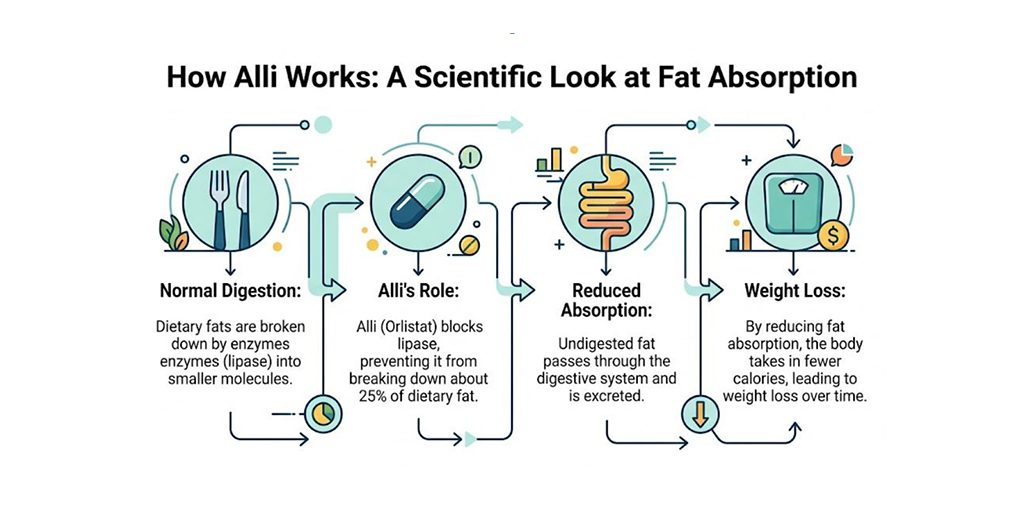
Alli is a lipase inhibitor. It works in the digestive tract, where it partially blocks the enzymes that break down fat from food. When that breakdown is incomplete, some dietary fat is not absorbed and leaves the body in stool. The FDA’s Alli prescribing information explains that orlistat, the active ingredient in Alli, can reduce absorption of dietary fat by about 25%.
That mechanism sounds technical, but the day-to-day meaning is simple. If less fat is absorbed, total calorie absorption can drop too.
How Alli differs from appetite-focused treatments
A lot of adults assume all weight loss medications do roughly the same job. They do not.
Alli does not target hunger centers in the brain. It does not make you feel full faster in the way some newer prescription medications can. Its effect is more mechanical. It changes what happens to part of the fat in a meal after you eat it.
That difference helps explain why Alli can be useful as more than a calorie-reduction tool. It creates fast, concrete feedback about meal composition. Lower-fat meals usually lead to a smoother experience. Higher-fat meals are more likely to lead to unwanted digestive effects.
For some people, that feedback becomes the actual value.
Why this can help build lasting habits
Alli is often described as a modest weight loss aid, but that description misses part of the story. Its design can help someone practice a skill. The skill is learning what a lower-fat eating pattern looks and feels like in real life.
That matters because nutrition advice is easy to agree with in theory and harder to apply on a Tuesday night when dinner is rushed. Alli shortens the gap between choice and consequence. You eat the meal, and your body responds in a way that teaches you whether the fat content was manageable.
In that sense, Alli works like training wheels for food awareness. The medication does not do the whole job for you. It helps you notice patterns faster, repeat what works, and avoid meals that reliably cause problems.
Why the low-fat eating pattern matters
Alli is meant to be paired with a reduced-calorie, lower-fat diet. The goal is not to outsmart a high-fat eating pattern. The goal is to support a pattern your body can tolerate and that you can keep using over time.
The manufacturer’s guidance for Alli advises spreading daily fat intake across meals and keeping meals moderate in fat, because higher-fat meals increase the chance of treatment effects in the digestive tract, as explained on the official Alli website’s guide to how the medication works.
Here is the sequence in plain language:
- You eat a meal that contains fat.
- Alli blocks part of the enzymes that would normally digest that fat.
- Some of the fat is not absorbed.
- That unabsorbed fat leaves the body.
- Meals that are lower in fat are usually easier to tolerate.
This is why Alli can teach as well as treat. It gives immediate feedback that can help a person build eating habits that remain useful with any weight loss strategy, including prescription treatments that work through different pathways.
Practical rule: Alli works best with consistent food choices, not as protection from high-fat meals.
That is its unique role in the current field of weight loss treatment. It offers modest medical help while also reinforcing a practical habit: choosing meals that are lower in fat, easier to tolerate, and often easier to sustain.
What Clinical Studies Say About Alli Results
A common scenario goes like this: someone sees “over-the-counter weight loss pill” and wonders whether the effect is real, or so small that it barely matters.
Clinical trials support a middle-ground answer. Alli can help with weight loss, but the effect is usually modest and depends heavily on using it with lower-calorie eating, lower-fat meals, and physical activity.
That may sound underwhelming at first. In clinical care, though, a modest effect can still be useful if it helps a person build habits they can keep.
What researchers found
Randomized trials and reviews of orlistat, the active ingredient in Alli, have generally found more weight loss with the medication than with lifestyle changes alone, according to the National Center for Biotechnology Information review of orlistat for obesity management. The added benefit is not usually dramatic. It is better understood as an extra push.
A good way to picture it is a hill with a slight incline. Walking still takes effort. Alli does not carry you uphill. It can make progress a little more likely when the day-to-day eating pattern fits how the medication works.
Why “modest” can still matter
In weight management research, a result does not have to be large to be meaningful.
A relatively small change in body weight can still matter when it lasts, improves health markers, or helps someone stay engaged with healthier routines. The Centers for Disease Control and Prevention explains that even losing 5% to 10% of starting weight can improve health in meaningful ways.
That context matters with Alli. The medication is not mainly valuable because it produces large losses. Its special role is that it can reinforce a lower-fat eating pattern through direct cause and effect. For some people, that turns an abstract nutrition rule into a practical skill.
What results usually look like in real terms
Study results tend to show a pattern rather than a dramatic before-and-after moment.
Early on, the bigger change is often behavioral. People learn which meals sit well and which ones do not. Over the following months, average weight loss with Alli tends to pull ahead of lifestyle efforts alone by a small amount, as summarized in the Alli prescribing and consumer information from DailyMed.
That is why expectations matter so much. If someone hopes for rapid, large-scale weight reduction, Alli will often feel limited. If someone wants an accessible tool that adds structure and feedback to eating decisions, the evidence makes more sense.
A more useful way to read the studies
The simplest summary is this: Alli works best as a support tool.
It can add a modest amount of weight loss. It can also teach. Meals higher in fat are more likely to create consequences a person notices, while lower-fat meals are usually easier to tolerate. That feedback loop can help turn “I should eat differently” into “I know how to eat in a way I can repeat.”
That skill has value beyond Alli itself. It can support long-term weight management whether a person stays with over-the-counter treatment, shifts to prescription medication, or works with a clinician on a more advanced plan.
Common Side Effects and How to Manage Them
This is the part many people want explained.
Alli’s most common side effects are digestive, and they’re closely tied to how much fat is in your meals. That’s because unabsorbed fat has to go somewhere. It passes through the digestive tract.
The side effects people notice most
Common effects can include oily spotting, loose stools, gas with discharge, and bowel urgency. These symptoms are often the reason people stop the medication early, especially if they start without understanding how tightly Alli is linked to meal fat.
That can sound like a pure downside. But there’s another way to understand it.
Why the side effects double as feedback
Alli is unusual because the side effects are often a real-time signal.
If someone eats a higher-fat meal and then has unpleasant digestive effects, the medication is basically teaching the body’s rule set: this approach goes better when fat intake stays lower and more evenly distributed.
For some people, that feedback is too annoying. For others, it becomes a strong form of accountability.
- High-fat meals tend to trigger problems
- More balanced meals tend to reduce surprises
- Consistency matters more than trying to “cheat” the system
That’s why Alli can function as a behavioral training tool, not just a weight loss pill.
Many people think side effects mean the medication is randomly harsh. With Alli, they often mean the meal and the medication weren’t well matched.
Practical ways to reduce side effects
You don’t need a perfect diet. You do need a deliberate one.
Here are the habits that usually make Alli easier to use:
- Keep fat moderate at each meal, instead of saving it for one heavier dinner
- Choose simpler cooking methods, such as baking, grilling, or steaming
- Watch hidden fats, especially in sauces, takeout, creamy dressings, and snack foods
- Learn from patterns, rather than treating each side effect as a mystery
A lot of adults do better when they treat the first few weeks as a learning phase. You’re not just taking a pill. You’re gathering information about what your body tolerates.
Important safety points
Because Alli reduces fat absorption, it can also reduce absorption of fat-soluble vitamins, including A, D, E, and K, as noted in the background material you provided. That’s why a daily multivitamin is commonly recommended, taken at a different time from Alli, often at bedtime.
Some people shouldn’t use Alli, or should check with a healthcare professional first, especially if they have certain digestive conditions, a history of nutrient absorption problems, or use medications that may interact with orlistat.
A good rule is simple:
| Situation | Smarter next step |
| Mild digestive effects after a fatty meal | Reassess the meal, not just the pill |
| Ongoing side effects despite lower-fat eating | Pause and seek medical guidance |
| Complex medical history or multiple medications | Get professional input before starting |
Build meals that are easy to repeat
Many don’t need a complicated plan. They need a repeatable one.
Try this simple framework:
- Start with lean protein, such as chicken breast, turkey, fish, tofu, or beans
- Add fiber-rich carbs, like fruit, oats, potatoes, brown rice, or beans
- Fill out the plate with vegetables
- Measure added fats, instead of pouring freely
- Keep restaurant meals in check, because hidden oils add up fast
If consistency has been hard in the past, resources on common weight loss challenges can help you spot patterns before they derail progress.
Take it correctly
Alli is designed to be taken with meals that contain fat. The background material notes 60 mg dosing three times daily alongside meals, with no need to take it if a meal has almost no fat.
That means:
- Take one capsule with a fat-containing meal
- Skip the dose if the meal is fat-free or very low in fat
- Don’t take extra, because more isn’t better here
Here’s a quick visual walkthrough of smart routine-building:
Don’t skip the vitamin habit
Because fat-soluble vitamin absorption can be reduced, taking a multivitamin at a separate time matters. Bedtime is often the simplest option because it keeps the routine clean.
Small habits do the heavy lifting with Alli. The pill matters, but meal planning, timing, and repetition matter more.
The adults who get the most out of Alli usually treat it as a structure tool. It supports quick wins, but its long-term value comes from the eating skills it reinforces.
The mindset that helps most
The people who do best with Alli usually don’t treat side effects as bad luck. They treat them as information.
That shift matters. It turns the experience from “this pill is punishing me” into “this tool is showing me what works.”
A Practical Guide to Using Alli for Best Results
Alli is easiest to use well when your routine is simple.
That doesn’t mean rigid. It means you know what the medication is for, when to take it, and how to build meals that don’t set you up for a rough afternoon.

Keep meals lower in fat and evenly balanced
The practical rule many people use with Alli is to aim for about 15 grams of fat per meal, based on the background guidance provided. That number helps make “low fat” concrete.
In real life, that often looks like:
- Breakfast: nonfat Greek yogurt, berries, and oats
- Lunch: grilled chicken salad with measured dressing
- Dinner: baked fish, rice, and vegetables
- Snack choices: fruit, low-fat dairy, or a lean protein option
A common mistake is eating very light all day and then having one rich dinner. Alli usually doesn’t reward that pattern.
How Alli Compares to Other Medical Weight Loss Options
A useful way to compare weight loss treatments is to ask a simple question first: what problem is each one trying to solve?
Alli is an over-the-counter version of orlistat. It works in the gut and reduces absorption of some of the fat you eat. Prescription GLP-1 medications work very differently. They act through hormone pathways that affect hunger, fullness, and how much food feels satisfying.
That difference matters because these options ask different things of the person using them. Alli is often best understood as a structure tool. It gives immediate feedback when a meal is too high in fat, which can help people learn patterns they may have missed before. GLP-1s are usually used when appetite regulation itself is a major barrier, or when someone needs a stronger medical effect than an OTC product is likely to provide.
Side-by-side comparison
| Attribute | Alli (OTC Orlistat) | Prescription GLP-1s (e.g., Semaglutide) |
| Access | Over the counter | Prescription required |
| Main mechanism | Blocks some dietary fat absorption | Affects appetite and satiety signaling |
| Where it works | Primarily in the digestive tract | Systemic hormonal effects |
| Typical role | Modest support, habit reinforcement | Higher-intensity medical treatment |
| Expected weight loss | More modest | Greater average weight loss in clinical practice and trials |
| Best fit | People seeking an accessible starting point | People who need more substantial medical support |
Clinical reviews of obesity medicines published by the National Institute of Diabetes and Digestive and Kidney Diseases describe this broader pattern clearly. Orlistat tends to produce modest average weight loss, while newer prescription medications, including GLP-1 based treatments, generally lead to larger average losses for appropriate patients. You can read that overview at the NIDDK page on prescription medications for treating overweight and obesity.
Where prescription orlistat fits
There is also a middle option within the same drug family. Xenical is prescription-strength orlistat. It uses the same basic mechanism as Alli, but at a higher dose and with clinician oversight.
That makes Xenical less like a different tool and more like a stronger version of the same tool. If someone does reasonably well with Alli’s approach, but needs a more medically guided plan, that can be part of the conversation with a clinician.
The practical advantage Alli still offers
Alli will not match the average weight loss seen with newer prescription medications. But that does not make it outdated. It gives something different.
It creates a direct connection between food choice and consequence. For some adults, that is highly teachable feedback. A rich restaurant meal is no longer just "off plan." It may lead to noticeable digestive effects, which makes the fat content of that meal much less abstract the next time. Over time, that can build a skill that matters with any treatment: noticing where extra fat is coming from and adjusting without needing perfect willpower.
That is why Alli can still have a role even now. It may serve as a starting point for someone who wants an accessible option, or as a habit-building phase before considering stronger treatment. If you want a clearer sense of how newer medications differ, this guide to GLP-1 drugs for weight loss explains where prescription therapy may fit.
Alli’s value is not just the pounds lost. It is also the eating awareness some people build while using it.
When to Consider a Professional Medical Consultation
You start with Alli because it feels approachable. Then a few weeks pass, and the core question becomes less about the pill itself and more about the bigger picture. Are you mainly trying to curb portions, learn lower-fat eating habits, address constant hunger, or improve weight-related health concerns that deserve more than self-directed trial and error?
That is the point where a medical visit can help.

Signs Alli may not be enough
Alli can be useful for adults who want an accessible starting point and who are ready to practice lower-fat eating. But some situations call for a wider lens. Consider medical guidance if any of these apply:
- You want more than modest weight loss, and you suspect an OTC option will not match your goals
- You have weight-related health issues, such as concerns about blood sugar, blood pressure, sleep apnea, or cholesterol
- You have repeated cycles of loss and regain, even when you make real effort with food and activity changes
- You take several medications, or have digestive, endocrine, or other health conditions that make self-treatment less clear
- You are not sure what is driving the problem, whether that is appetite, cravings, meal structure, emotional eating, or an underlying medical issue
A clinician helps sort out which of those is the main obstacle. That matters because different problems respond to different tools.
Why guidance can save time
Alli works on one specific target. It reduces absorption of some of the fat you eat. For some people, that creates very practical feedback and helps build a lower-fat eating pattern they can carry into the long term.
But weight management is not always a fat-absorption problem.
If hunger is intense, if portions feel hard to control, or if medical conditions are shaping your metabolism and health risks, another treatment approach may fit better. A clinician can also help you tell the difference between “this is not working” and “this tool is useful, but it is only addressing one part of the problem.”
That kind of clarity can prevent months of guessing.
A balanced next step
Using Alli first can still be reasonable. It can teach food awareness in a concrete way, almost like training wheels for label reading and meal choices. If that feedback helps you build habits and you are seeing steady progress, great.
If your situation is more complex, a professional evaluation may be the smarter next step. TRAVA is one telehealth option that connects patients across the U.S. with licensed, board-certified medical providers for personalized weight loss plans that may include GLP-1-based therapy, NAD+, or Sermorelin when appropriate.
The goal is a good match between the tool and the problem.
If you have been wondering does Alli work for weight loss, a fair answer is yes, for modest support and habit-building. If you need stronger appetite control, closer monitoring, or treatment built around other health conditions, medical guidance can help you choose an option that fits your body and your goals.
Disclaimer: TRAVA is not affiliated with, Mounjaro, Ozempic, Rybelsus, Saxenda, Trulicity, Wegovy, or Zepbound. However, we do offer alternatives such as Semaglutide and Tirzepatide. Before beginning any treatment, it's essential to consult with a licensed healthcare provider to ensure the best approach for your individual health needs.