
You may be looking at peptide therapy from two very different starting points.
One path starts with weight loss. You’ve done the food tracking, tried the supplements, maybe started a GLP-1, and now you want to protect muscle, support recovery, and feel more steady while your body changes.
The other path starts with longevity. Sleep doesn’t feel as deep as it used to. Recovery takes longer. Energy is fine on paper, but not quite where you want it. You’re interested in therapies that work with the body’s own signaling rather than forcing a blunt hormonal effect.
That’s where ipamorelin and sermorelin often enter the conversation. They sit in the same general category, but they aren’t interchangeable. Both are used to encourage the body’s own growth hormone signaling. They just do it in different ways, and those differences matter when you’re choosing a treatment plan with a provider.
Starting Your Advanced Wellness Journey
A common scenario looks like this. Someone in their 40s has made progress with lifestyle changes, maybe added a GLP-1, and feels better overall. But they still notice slower recovery after workouts, disrupted sleep, or a softer body composition than they expected.
Another person is less focused on the scale and more focused on staying sharp and active over time. They want science-backed support that feels safe, reliable, and designed for consistency, not a flashy shortcut.

In both cases, peptide therapy can sound promising and confusing at the same time. The names are similar. The goals overlap. Online advice often turns a nuanced medical topic into a simple “which one is better” debate.
That’s usually the wrong question.
A more useful question is this: which therapy fits your actual goal, your timeline, and your provider’s clinical judgment? For some people, the priority is metabolic support and body composition. For others, it’s gradual support for sleep, recovery, and healthy aging. Some people also look at peptide therapy alongside broader wellness options, such as NAD+ injections in Providence, Rhode Island, as part of a more complete plan.
Personalized Compounded Sermorelin
Looking for peptide therapy? Start your free assessment now!
A quick early comparison
| Attribute | Sermorelin | Ipamorelin |
| Core category | GHRH analog | Selective ghrelin receptor agonist |
| General style | Foundational, steady support | Targeted, shorter-acting support |
| Common focus | Sleep, recovery, long-term hormone balance | Fat loss, muscle recovery, body composition |
| Typical schedule | Often at bedtime | Often once or twice daily |
| Regulatory context | Previously FDA approved for a pediatric indication | Not FDA approved |
Most confusion comes from assuming both peptides do the same thing. They don’t. They point the same system in a similar direction, but they use different biological signals.
Understanding How Peptide Therapy Works
Growth hormone gets talked about in extremes. Some people treat it like a miracle answer. Others avoid the topic because it sounds risky or overly technical.
The middle ground is more useful.
What growth hormone signaling actually does
Growth hormone helps regulate several processes tied to everyday wellness. That includes metabolism, lean mass maintenance, tissue repair, and recovery. When people talk about wanting better sleep, steadier body composition, or improved training recovery, they’re often talking about systems that overlap with growth hormone signaling.
That doesn’t mean more is always better. It means the body already runs this system for a reason.
In healthy physiology, growth hormone is released in pulses. It isn’t meant to stay flat all day. The body uses feedback loops to keep that rhythm in check.
Where peptides fit in
Peptide secretagogues are best understood as signaling tools. They aren’t the same as injecting growth hormone directly. Instead, they encourage your own body to release growth hormone through established pathways.
That distinction matters.
Direct hormone replacement pushes the end product into the system. Secretagogues try to stimulate the body upstream. For many patients and providers, that feels more aligned with how the body naturally regulates itself.
If you’re also thinking about body composition, recovery, and sustainable routines, this broader view of how to boost metabolism naturally helps frame where peptide therapy may or may not fit.
Why people mix up HGH and peptide therapy
The terms get blurred online. “Growth hormone support” can refer to very different treatments.
Here’s the plain-language version:
- Direct HGH therapy: Delivers synthetic growth hormone itself.
- Peptide therapy: Encourages the pituitary and related pathways to release growth hormone more naturally.
- Clinical goal: Often overlaps, but the mechanism and practical decision-making are different.
That’s why a thoughtful provider won’t just ask whether you want fat loss or anti-aging support. They’ll also look at how aggressive or gentle the signaling approach should be.
The safety logic behind secretagogues
One reason these therapies attract interest is that they work with hormonal signaling rather than replacing the final hormone. In practical terms, providers often think about whether a treatment preserves feedback patterns instead of overriding them.
Practical rule: If a therapy affects hormones, the most useful question isn’t “does it work?” It’s “how does it work, and what kind of monitoring does it require?”
That’s where ipamorelin and sermorelin start to separate. One acts more like a foundational nudge. The other acts more like a targeted trigger.
Sermorelin Explained A Foundational Approach
Sermorelin is often the easier starting point for people who want a more physiologic approach to growth hormone support.
It’s a synthetic analog of growth hormone-releasing hormone, or GHRH. In simple terms, it mimics one of the body’s own upstream signals that tells the pituitary gland to release growth hormone.
Why Sermorelin feels more “foundational”
Sermorelin works at the GHRH receptor. It encourages the body to release growth hormone in a way that mirrors natural pulsatile signaling.
That’s a big reason it’s often discussed in the context of sleep, recovery, and gradual body composition support rather than rapid physique-focused changes.

A published overview notes that sermorelin was approved by the FDA in 1997 for treating children with idiopathic growth hormone deficiency, and that it binds exclusively to GHRH receptors, mimicking natural pulsatile GH secretion without suppressing somatostatin. The same source notes that typical dosing ranges from 150 to 300 mcg per injection, often at bedtime, with benefits described as modest lean muscle gain, fat reduction, improved sleep, and recovery, per Hone Health’s sermorelin vs ipamorelin review.
What that means in real life
People are often surprised that sermorelin is not mainly discussed as a “muscle drug.” It’s usually a better fit for someone who wants to support the rhythm behind recovery.
That can matter if your goals include:
- Sleep quality: Bedtime dosing is often used to align with natural nighttime growth hormone pulses.
- Gradual body composition support: Changes may build more slowly and feel less dramatic.
- Healthy aging: Many patients are drawn to sermorelin because it supports natural hormone signaling instead of bypassing it.
Who usually considers Sermorelin
Sermorelin often appeals to adults who are new to peptide therapy and want a more measured approach. It’s also common in conversations about longevity, especially when the person’s goals are broad and not purely performance-driven.
A few examples:
- A professional in their 50s who wants better recovery and sleep consistency.
- A GLP-1 user who wants to preserve lean mass and support energy while losing weight.
- Someone interested in anti-aging support, but wary of anything that sounds too aggressive.
What makes its mechanism distinct
Sermorelin doesn’t suppress somatostatin, the hormone that helps regulate growth hormone release. That detail sounds technical, but the takeaway is simple. Its action tends to preserve the body’s existing checks and balances.
Sermorelin tends to appeal to people who want hormone support that feels closer to a nudge than a shove.
Practical expectations
Ipamorelin Explained A Targeted Approach
If Sermorelin is the foundational option, Ipamorelin is often the more targeted one.
It’s typically discussed by people who care about body composition, workout recovery, and a more directed metabolic effect. That includes adults using weight-loss therapies who don’t just want to lose pounds, but also want to think carefully about muscle preservation and recovery.

How ipamorelin works differently
Ipamorelin is a selective ghrelin receptor agonist. Instead of acting like GHRH, it triggers growth hormone release through the ghrelin receptor pathway.
That different route matters because it shapes the kind of response providers are looking for. In the verified data, ipamorelin is described as stimulating growth hormone release without elevating cortisol or prolactin, which is one reason it gets attention in weight-management settings. The same source notes that animal studies indicate a half-life of 2 to 3 hours, that it inhibits somatostatin, and that it’s often associated with enhanced IGF-1 rises, fat loss, and muscle toning. It also notes that ipamorelin lacks FDA approval for human GH trials and is often compounded in telehealth care, according to this review of sermorelin, CJC-1295, and ipamorelin.
Why people call it “targeted”
The easiest way to understand ipamorelin is to think of it as a more precise prompt for short, controlled growth hormone pulses.
That often lines up with goals like:
- Body composition support
- Exercise recovery
- Preserving lean tissue during weight loss
- A more noticeable performance-oriented approach
These are exactly the kinds of goals that come up after someone has already built a decent health routine and wants the next level of medical guidance.
Who tends to ask about it
Ipamorelin usually comes up in a narrower decision context than sermorelin. The conversation is less about “general wellness” and more about “what am I trying to improve right now?”
That may include:
- Adults pursuing fat loss while trying to maintain muscle
- Active people who care about recovery between workouts
- Patients who want a peptide option with a cleaner stimulation profile
What to keep in mind
Ipamorelin’s appeal is also what makes good screening important. A targeted therapy still needs a targeted reason.
A provider should be able to explain:
- Why this mechanism fits your goal
- How the medication will be sourced and monitored
- What outcome would count as meaningful progress
A peptide shouldn’t be chosen because it sounds advanced. It should be chosen because its signaling pathway matches the problem you’re trying to solve.
Side by Side Comparison Ipamorelin vs Sermorelin
The fastest way to get lost in peptide therapy is to compare names instead of comparing goals.
Ipamorelin and sermorelin both support endogenous growth hormone release, but they do it through different receptors, with different timing, and often for different reasons in practice.
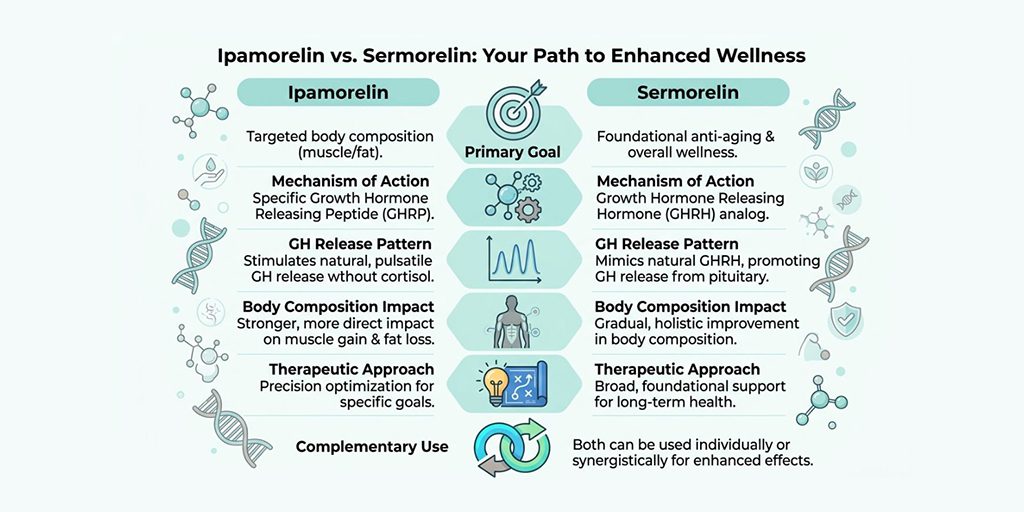
Ipamorelin vs Sermorelin at a Glance
| Attribute | Sermorelin | Ipamorelin |
| Peptide type | GHRH analog | Selective ghrelin receptor agonist |
| Main signaling route | GHRH receptor | Ghrelin receptor |
| Half-life | 10 to 30 minutes | About 2 hours |
| Release style | More physiologic, steady stimulation | Rapid, controlled GH spikes |
| Typical use pattern | Often nightly | Often once or twice daily |
| Best fit for | Beginners, longevity-minded adults, gradual support | Fitness goals, fat loss focus, recovery support |
| Overall feel | Foundational | Targeted |
A clinical wellness review describes ipamorelin as a selective ghrelin receptor agonist with a 2-hour half-life for rapid GH spikes, while sermorelin is described as a GHRH analog with a 10 to 30 minute half-life that promotes more physiologic, steady GH stimulation for long-term hormone balance. The same review says wellness protocols often recommend ipamorelin for fitness goals and sermorelin for beginners or those seeking mild, anti-aging support, in Tucson Wellness MD’s comparison.
If your goal is metabolic support
For many telehealth patients, “metabolic support” means more than one thing. It may include body composition, energy, recovery, and sleep.
In that setting, the distinction often looks like this:
- Sermorelin: Better aligned with broad, long-view wellness goals
- Ipamorelin: Better aligned with narrower, more immediate body composition goals
That doesn’t make one superior. It means each one answers a different clinical question.
If your goal is performance and recovery
Ipamorelin usually becomes more compelling. Its shorter-acting profile and targeted signaling are often discussed in relation to muscle recovery, fat loss support, and a quicker-feeling onset.
Sermorelin can still help recovery, but it’s usually chosen for its steadier rhythm rather than a more acute performance angle.
If your goal is longevity and consistency
Sermorelin tends to make more sense for people who want something that integrates smoothly into a long-range wellness plan. Sleep and recovery support matter here, but so does the philosophy of treatment.
Some patients prefer a peptide that mirrors the body’s own upstream growth hormone signaling more directly.
Key distinction: Ipamorelin often matches a “specific target” mindset. Sermorelin often matches a “steady foundation” mindset.
How speed affects expectations
People often ask which peptide “works faster.” That can be the wrong frame unless you define what “working” means.
If you mean a therapy aimed at acute fat loss support and workout recovery, ipamorelin is often the more natural fit. If you mean a therapy aimed at gradual support for sleep, recovery rhythm, and long-term hormone balance, sermorelin usually fits better.
That’s why providers should tie the choice to one measurable purpose, not a vague wish list.
Combination use
Some wellness protocols use both peptides together under medical supervision. The logic is straightforward. They act through different pathways, so a provider may decide there’s value in combining a foundational signal with a more targeted one.
That decision should always be individualized.
- A few questions help sharpen the discussion:
What is the main goal right now? Fat loss support, sleep, recovery, or broad longevity support.
- How quickly do you expect to notice changes? Faster expectations can push the conversation toward a different option.
- Do you want a simple routine or a more customized protocol? Convenience matters if consistency is the actual goal.
- What are you already taking? GLP-1s, recovery supplements, and other therapies can shape the recommendation.
The simplest way to decide
Sermorelin often makes more sense when the person wants a broad, gentle, foundational therapy.
Ipamorelin often makes more sense when the person wants a more directed strategy for body composition and recovery.
That’s the practical divide. Most of the complexity online is just detail around that central point.
Choosing Your Therapy Through Telehealth
Good telehealth care doesn’t start with a peptide. It starts with a reason.
A provider needs to understand what you want to improve, what you’ve already tried, how your schedule works, and whether the treatment burden makes sense for real life. That’s especially important with therapies that may be dispensed through compounding.
What a telehealth evaluation should cover
A useful visit usually centers on a few practical questions:
- What’s your primary goal? Weight loss support, lean mass preservation, recovery, sleep, or healthy aging.
- What’s your baseline? Current medications, health history, symptoms, and lifestyle patterns matter.
- What’s realistic for adherence? A nightly injection schedule fits some people well. Others do better with a different cadence.
- How will progress be judged? The answer shouldn’t be “just see how you feel.”
This is also why many patients benefit from learning what telehealth is before they book. The format can be convenient, but the standard should still feel medically grounded.
Why compounded medications come up
In peptide care, compounded medications are part of the practical conversation. Providers may use them when they believe a customized formulation is clinically appropriate.
That doesn’t mean “customized” automatically means better. It means the provider should be transparent about what is FDA approved, what is compounded, and why that choice is being made.
The publisher of this article, TRAVA, is one telehealth service that connects patients with licensed, board-certified providers across all 50 states and works with state-licensed pharmacies, including USP-compliant U.S. facilities when compounded medications are prescribed as clinically necessary. The company states that 94% of users report improvement in under 70 days through its broader personalized protocols.
Questions worth asking in your appointment
Some questions lead to a much better visit than “which peptide is best?”
Try these instead:
- What specific outcome are we targeting first?
- Why does this peptide fit that goal better than another option?
- Is this medication FDA approved, previously approved, or compounded?
- How often would I take it, and how does that fit my routine?
- What signs would tell us the plan is working, or not working?
The best telehealth visits feel collaborative. You should understand the treatment logic, not just the treatment name.
A decision framework that keeps things clear
If your provider is helping you choose between ipamorelin and sermorelin, the recommendation should connect directly to three factors:
- Your main goal
- Your tolerance for complexity
- Your preference for a gradual or more targeted approach
That’s how peptide therapy stays practical instead of turning into guesswork.
Frequently Asked Questions about Peptide Therapy
Can ipamorelin and sermorelin be used together
Yes, some protocols use both together under medical supervision.
The rationale is that they work through different signaling pathways. Sermorelin uses a GHRH-style route. Ipamorelin uses a ghrelin receptor route. A provider may decide that a combined approach makes sense when the patient’s goals include both broad hormone support and more targeted body composition or recovery support.
What matters is the reasoning. Combination therapy should have a clear purpose and a monitoring plan.
How long does it take to notice a difference
The answer depends on what kind of difference you’re looking for.
Ipamorelin is commonly described as the more acute option for fat loss support and muscle recovery, so some people pursue it when they want a faster-feeling shift in recovery or body composition. Sermorelin is commonly framed as the slower, steadier option for sleep, recovery rhythm, and long-term hormone balance.
That’s why timeline questions should always be paired with outcome questions. “When will I notice something?” is only useful if you also ask, “What exactly am I hoping to notice?”
Are these the same as taking HGH
No.
The key difference is that peptide therapy encourages the body’s own growth hormone release rather than injecting growth hormone directly. That’s why the conversation often focuses on signaling pathways, pulse patterns, and feedback loops.
For many adults, that difference is a major reason these therapies are even being considered.
Are these therapies only for athletes or bodybuilders
Not at all.
A lot of interest comes from ordinary adults who are thinking about weight loss, healthy aging, recovery, or energy. Some are already on GLP-1 medications and want to think more carefully about muscle preservation and overall metabolic health. Others are not focused on weight loss at all and care more about longevity and function.
How do peptide therapies compare with GLP-1 medications
They work through different systems.
GLP-1 medications are generally discussed in relation to appetite, blood sugar regulation, and weight loss. Ipamorelin and sermorelin are discussed in relation to growth hormone signaling, recovery, body composition support, and hormone rhythm.
That means they aren’t direct substitutes for each other. In some clinical settings, they may be considered complementary pieces of a broader plan.
Is one peptide safer than the other
That’s too broad to answer without context.
The safer choice is the one that fits the right patient, the right goal, and the right level of supervision. Sermorelin has a more established historical profile in clinical use. Ipamorelin is often described as having a gentle stimulation profile, particularly because it’s discussed as not elevating cortisol or prolactin in the verified material.
But “safe” never means casual. These are still therapies that affect hormonal signaling.
A good sign is when your provider talks as much about fit and monitoring as they do about benefits.
Why does the compounded status matter
Because product context matters.
Some peptide therapies are encountered through compounding rather than as currently marketed FDA-approved drugs. Patients should know exactly what they’re receiving and why that route was chosen. A credible prescriber should explain the sourcing path in plain language and answer questions directly.
What kind of person usually starts with sermorelin
Often, it’s someone who wants a more foundational approach.
They may be newer to peptide therapy. They may care about sleep, recovery, and healthy aging more than gym performance. They may also prefer a nightly rhythm that aligns with the body’s natural growth hormone pattern.
What kind of person usually starts with ipamorelin
Often, it’s someone with a more defined body composition or recovery goal.
That could be an active adult trying to support muscle while losing weight, or someone looking for a more targeted peptide conversation rather than a broad anti-aging approach.
What should you bring to your provider conversation
Keep it simple and specific:
- Your primary goal
- Your current medications and supplements
- Your daily routine
- The changes you want to measure
- Any concerns about injections, compounding, or long-term use
That information usually matters more than how much online research you’ve done.
Disclaimer: TRAVA is not affiliated with, Mounjaro, Ozempic, Rybelsus, Saxenda, Trulicity, Wegovy, or Zepbound. However, we do offer alternatives such as Semaglutide and Tirzepatide. Before beginning any treatment, it's essential to consult with a licensed healthcare provider to ensure the best approach for your individual health needs.